How to Setup a Business in Dubai: Guide to Company Formation (2026)
Published Date:
Last Updated:
Dubai has firmly established itself as a premier global hub for visionary capital and institutional stability. In 2026, it stands as a global economic fortress, with national growth projected above 5% and a regulatory landscape that offers unmatched clarity for multinational corporations and high-growth startups.
Company formation in Dubai has evolved into a fully integrated digital process with the Dubai Unified License (DUL), enabling businesses to launch and scale with speed and transparency.
For global founders, navigating jurisdiction selection and tax compliance in a post-Pillar Two era still requires strategy. This guide provides practical insights and steps to establish your presence in Dubai’s "New Economy," from choosing a Mainland or Free Zone structure to securing premium infrastructure at One Za’abeel.
What Makes Dubai an Attractive Business Hub
Dubai offers a uniquely favorable environment for business, combining strategic positioning, regulatory maturity, and cutting-edge infrastructure. Several key pillars make the city a top choice for global investors:
Strategic Location and Connectivity
At the crossroads of Europe, Asia, and Africa, Dubai enables companies to reach international markets within a single working day. This connectivity is supported by world-class logistics, including the Etihad Rail network and major air hubs that facilitate seamless trade.
Unrivalled Market Accessibility
Dubai acts as the primary gateway to the Middle East, Central Asia, and Africa, allowing businesses to expand efficiently. The UAE’s Comprehensive Economic Partnership Agreements (CEPA) in 2026 further reduce trade barriers, streamlining international scaling.
Political and Economic Stability
Predictable regulations and a stable political environment provide a secure foundation for long-term investments. With low inflation and a currency pegged to the US Dollar, Dubai offers protection against global economic volatility.
Advanced Modern Infrastructure
Heavy investment in telecommunications, energy, and digital platforms, such as 6G trials and AI-driven government services, supports business growth. Free zones and industry clusters offer tailored incentives and streamlined digital regulations, enabling new entities to thrive from day one.
Global Talent and Quality of Life
Dubai attracts top-tier professionals with low crime, excellent lifestyle, and advanced residency schemes like the Golden Visa and Green Visa. This diverse talent pool fuels a culture of innovation, making recruitment and business expansion more efficient.
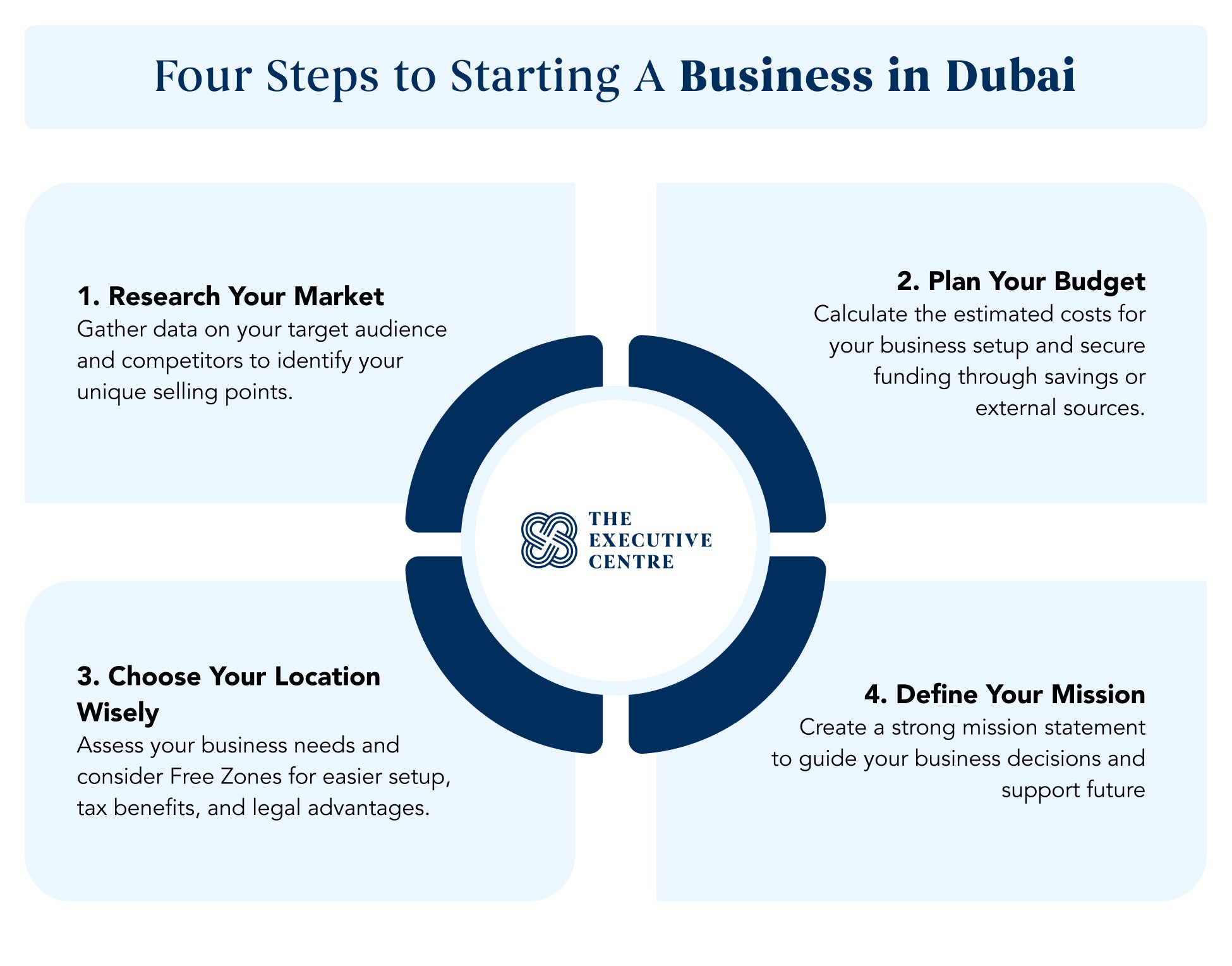
Four Essential Steps to Start a Business in Dubai
Before diving into legal formalities, it is essential to build a solid foundation for your venture. These early steps help define your direction, minimize operational risks, and set the stage for a smooth, digital-first registration process.
Step 1: Research the Market
The Dubai market is increasingly data-driven. Begin with an in-depth analysis of your target audience and current industry trends. Tools like the Dubai National Economic Register or AI-powered predictive analytics can help identify market gaps, ensuring your offering is tailored to a high-tech, sustainable business environment.
Step 2: Plan Your Budget and Funding
Financial transparency is a hallmark of the current regulatory landscape. Accurately estimate startup costs, including license fees, premium office space, and mandatory 9% Corporate Tax compliance. Decide whether to use personal capital or leverage Dubai’s thriving venture capital ecosystem. Clear financial planning is now a prerequisite for smooth corporate bank account openings.
Step 3: Choose the Strategic Location
Selecting your jurisdiction, Mainland or Free Zone, is one of the most critical decisions in your setup journey. Location impacts cost structure, regulatory compliance, and eligibility to bid for government contracts. For businesses requiring "tax substance" under 2026 laws, a prestigious address in districts like Business Bay or One Central provides the credibility and physical presence needed to satisfy regulators and international clients.
Step 4: Define Your Vision and Business Plan
Outline your mission, vision, and key objectives in a comprehensive business plan. This document serves not only as an internal roadmap but also as verification for banks and authorities regarding your Ultimate Beneficial Ownership (UBO) and operational model. A well-defined plan keeps your team focused and accelerates approvals for visas and corporate facilities.
Tip: Including an "ESG and Digital Transformation" section in your business plan can give a competitive edge when applying for government-backed incentive schemes.
Once this groundwork is in place, the next stage is formal registration and licensing, the legal process that brings your business to life.
How to Register Your Business in Dubai
Registering a business in Dubai has evolved into a digital-first experience. With the Dubai Unified License (DUL) and the Invest in Dubai platform, the process from application to operation is faster and more transparent than ever.
While requirements vary by activity, registration generally includes the following stages:
1. Choose a Legal Structure
Select the structure that best aligns with your long-term goals:
Limited Liability Company (LLC): Standard for mainland trading.
Sole Establishment: Best for professional services and consultancy.
Branch of a Foreign Company: For international firms expanding locally.
Your choice affects ownership, liability, and compliance under UAE Commercial Companies Law.
2. Select a Trade Name
Reserve a trade name that complies with Department of Economy and Tourism (DET) regulations. Digital portals check for uniqueness and restricted terms instantly, so reserving early helps avoid delays later.
3. Obtain Initial Approvals and Activity-Specific Licenses
Certain businesses, like health-tech or industrial firms, require approvals or "no-objection" certificates before final registration. Many approvals are now processed through a single-window digital system.
4. Register for the Dubai Unified License (DUL)
Submit your documents to the DET (mainland) or your Free Zone authority. The DUL provides a unique QR code that serves as your digital identity across all government and private sector services.
5. Register with Municipal Authorities
Complete registration with Dubai Municipality or other relevant authorities to meet health, safety, and environmental standards, especially important for retail, F&B, and industrial sectors.
6. Open a Corporate Bank Account
The DUL streamlines corporate banking. By sharing your QR code, banks can complete KYC in as little as five working days, allowing secure financial operations almost immediately after incorporation.
7. Secure Residency and Employment Visas
Foreign investors and teams need residency visas. Many qualify for the 10-year Golden Visa, offering stability without a local sponsor. Professional guidance ensures visas are processed efficiently.
Requirements vary by activity and location. With Resolution No. 11 of 2025, some Free Zone entities can now trade on the mainland. Expert enterprise solutions are recommended to navigate these rules while you focus on building your business.
Choosing the Right Business Structure for Your Dubai Setup
Selecting the proper business structure is a crucial step when starting a business in Dubai. Your choice affects operational control, compliance with the UAE’s 9% Corporate Tax, and eligibility for Small Business Relief.
The primary legal forms recognized under the UAE Commercial Companies Law include:
Sole Establishment
Owned by a single individual, the owner maintains full control and profit rights. Foreign owners can establish a mainland sole establishment for most service-based activities, provided they hold a valid residence permit. Owners remain personally liable for all debts, making this ideal for consultants and freelancers with low-risk operations.
Limited Liability Company (LLC)
The most popular structure in Dubai, an LLC protects shareholders’ personal assets, limiting liability to their capital contribution. Recent updates allow multiple share classes with varied voting and dividend rights, offering more flexibility for capital structuring.
Civil Company
Designed for professional or intellectual services like doctors, lawyers, and engineers. Partners are generally fully liable for professional activities. This structure is suitable for specialized boutiques where expertise is the primary asset.
Private and Public Shareholding Companies
Private Shareholding Company
Requires at least three shareholders; suitable for large commercial or industrial ventures. Reforms now allow private securities placement.
Public Shareholding Company (PJSC)
Open to public investment, subject to strict oversight. Names must be neutral unless trademarked.
Branch of a Foreign Company
Extends the parent company’s legal identity into Dubai. The DUL system now streamlines registration. Branches must operate under the same name and ownership as the parent to remain compliant.
Partnership Company
Two or more individuals co-own a business through a General or Limited Partnership. General Partnerships involve unlimited liability for all partners; Limited Partnerships allow "silent partners" with liability limited to capital contribution. These are typically used by experienced local investors.
Choosing a Trade Name for Your Business Setup in Dubai
Your trade name is more than just a label; it is your brand’s first impression in one of the world's most competitive markets. Trade name registration is a strictly regulated process governed by the Department of Economy and Tourism (DET). We assist our members in navigating these requirements to ensure their brand identity is both impactful and legally compliant.
Below is a breakdown of the process and requirements to help you secure your preferred name on the first attempt.
1. Process for Registering a Trade Name
The registration process has been significantly accelerated through the Invest in Dubai digital ecosystem, allowing for real-time availability checks.
Step 1: Check availability through the DET portal or the Dubai Unified License (DUL) integrated search tool.
Step 2: Submit your application electronically along with your initial activity approval.
Step 3: Pay the trade name reservation fee (typically valid for six months in 2026).
Step 4: Receive your official approval and digital reservation certificate.
Step 5: Integrate the approved name into all legal, digital, and commercial documents.
Note: Reserving a unique, compliant name early is a strategic move that prevents administrative bottlenecks during the final licensing phase.
2. Trade Name Requirements and Restrictions
The UAE maintains high standards for corporate naming to protect cultural values and market integrity. We ensure our members adhere to both legal content restrictions and technical formatting rules.
A. Legal & Content Restrictions
Public Morals: The name must not violate public order or the cultural sensibilities of the UAE.
Restricted References: It cannot contain references to religion, specific political groups, or local government entities.
Personal Names: If using a person’s name, it must be the full name (first and last) of the shareholder; surnames alone are generally not permitted.
Global Trademarks: You must avoid using well-known global brand names unless you possess an official franchise or licensing agreement.
B. Formatting and Linguistic Rules
The DET's automated systems are highly specific regarding how a name is presented:
Activity Alignment: The name must accurately reflect the primary business activity (e.g., a "Trading" company cannot be named "Consultancy").
Suffixes: Abbreviations like “Ltd.,” “Inc.,” or “LLC” are not part of the trade name itself but are added as a legal suffix later.
Language: The name must be registered in both Arabic and English (or accurately transliterated).
Character Limits: No special characters, exclamation marks, or non-standard punctuation are allowed.
C: Prohibited Terms and Compliance Guide
Term Category | Examples Not Allowed | Reason for Restriction |
Legal Suffixes | “Limited”, “Inc”, “Corp” | Reserved for legal structure, not the trade name. |
Religious Terms | “Allah”, “Makkah”, “God” | To protect cultural and religious sensitivity. |
Political References | “Political”, “Government” | To maintain neutrality and prevent misrepresentation. |
Global Brands | “Apple”, “Amazon” | To prevent trademark infringement and legal disputes. |
Why It Matters
Complying with these guidelines is about more than just checking a box; it speeds up your approvals and prevents costly rebranding exercises. Your trade name is automatically linked to your DUL QR code, meaning any errors in the initial stage will ripple through your banking and visa applications. Taking the time to get it right from the start ensures your brand reflects the professional excellence we stand for.

How to Choose the Right Jurisdiction for Your Dubai Business Setup
Selecting the right jurisdiction is a strategic decision that depends on your industry, target market, and long-term growth plans. Dual-licensing frameworks have increased flexibility, but the fundamental distinction between Mainland and Free Zone remains central to UAE company formation.
Free zones are ideal for businesses requiring specialized facilities, such as advanced labs or logistics hubs. Mainland jurisdictions are preferred for companies engaging directly with the local market and bidding for high-value government contracts.
Free Zones for Business Setup in Dubai
Free zones offer 100% foreign ownership and sector-specific ecosystems. Dubai hosts over 30 free zones catering to industries like technology, media, and healthcare.
Under the UAE Corporate Tax regime, free zone entities can retain a 0% tax rate if they maintain "Adequate Substance," including physical offices and qualified staff. Premium locations such as One Central at DWTC help meet these requirements while providing customs privileges and streamlined registration.
Mainland Jurisdictions for Business Setup in Dubai
Mainland setups allow unrestricted operations across the UAE. This is ideal for retail, construction, and service-based companies that need to be close to onshore clients.
Recent Legal Changes
Amendments to the Commercial Companies Law now allow 100% foreign ownership for over 1,000 commercial and industrial activities, removing the historical need for a local sponsor in most sectors. Certain "Strategic Impact" activities, such as banking, insurance, and defense, still require local partners or federal approval.
Dual-Licensing and Resolution No. 11
Executive Council Resolution No. 11 of 2025 enables free zone companies to operate on the mainland under a permit or branch license from the DET, without forming a separate entity.
At One Za’abeel and One Central, we support this dual-licensing model, hosting both DWTC Free Zone and DED Mainland tenants on the same floor for seamless operational flexibility.
A Strategic Comparison: Mainland vs. Free Zone
Choosing between a Mainland and Free Zone setup is no longer just about ownership; it is about balancing market access with the UAE Corporate Tax framework. While the Dubai Unified License (DUL) has streamlined digital processes, operational distinctions remain critical for long-term strategy.
Criteria | Mainland (DET) | Free Zone (Tier-1) |
Ownership | 100% foreign ownership for over 1,000 commercial and industrial activities. | 100% foreign ownership across all permitted sectors. |
Business Scope | Can trade anywhere in the UAE and bid for all government contracts. | Traditionally limited to the zone; now accessible via Resolution 11 permits or branch licenses. |
Workspace | Mandatory physical office (minimum 200 sq. ft. for most licenses). | Flexi-desks and virtual offices are widely available for startups. |
Corporate Tax | Standard 9% tax on profits exceeding AED 375,000. | 0% tax on "Qualifying Income," provided the entity maintains "Adequate Substance." |
Audit Requirement | Mandatory annual audit to maintain compliance and transparency. | Mandatory audit for those claiming 0% tax; requirements vary by zone. |
Visa Quotas | Generally linked to office size (approx. 1 visa per 80 sq. ft.). | Fixed quotas per license; can be increased by upgrading office packages. |
Regulatory Body | Governed by the Dubai Department of Economy and Tourism (DET). | Governed by independent Free Zone Authorities. |
Final Steps and Next Moves for Your Dubai Business
Launching a business in Dubai is a journey that combines strategic planning with compliance and operational clarity. From choosing the right jurisdiction and legal structure to securing your Dubai Unified License and municipal approvals, each step ensures your venture is built on a solid foundation for growth. Leveraging the city’s advanced infrastructure, streamlined digital processes, and regulatory transparency allows founders to focus on scaling their business efficiently.
By understanding corporate tax obligations, visa requirements, and licensing nuances, and seeking professional guidance when needed, you can navigate Dubai’s business landscape with confidence. Whether you’re aiming to access local markets via Mainland setup or take advantage of Free Zone incentives, careful preparation ensures your business thrives in this dynamic global hub.
Key Takeaways
Conduct thorough market research and define your business plan.
Choose the legal structure and jurisdiction that align with your goals.
Reserve and register your trade name early to avoid delays.
Leverage digital platforms like the Dubai Unified License for faster approvals.
Engage expert guidance for licensing, compliance, and dual-licensing opportunities.
Industry Insights
Lifestyle
Professional Development

Ketan specialises in flexible office solutions across the UAE and Saudi Arabia. With a background as VP at Barclays leading strategic transformation and flex office initiatives, he brings deep knowledge in corporate real estate and business growth across the region.
Table of Contents
DWTC LEASE CALCULATOR
AVG. Saving
Starts from

Frequently Asked Questions
How much does it cost to start a business in Dubai?
Free Zones: Leaner packages (license + flexi-desk) can start as low as AED 12,500.
Mainland: Costs usually start around AED 22,000, accounting for mandatory physical office space (Ejari) and the new Dubai Unified License (DUL) registration fees. Premium locations and specialized industrial licenses will naturally sit at the higher end of this scale.
Can a foreigner start a company in Dubai?
Yes. In 2026, the UAE is one of the most open economies globally. Foreigners can enjoy 100% ownership in both Free Zones and most Mainland sectors. Furthermore, through the "Invest in Dubai" platform, the entire registration process can be completed digitally from anywhere in the world, allowing you to secure your license and DUL QR code before even landing in the city.
Which business is most profitable in Dubai?
Dubai’s "New Economy" focus has shifted profitability toward high-tech and sustainable sectors. The most lucrative ventures include AI Solutions, Fintech & Blockchain, E-commerce, and Green Energy Consulting. Traditional powerhouses like Real Estate, Tourism, and Specialized Healthcare continue to show robust returns as the population nears the 4 million mark.
How can I start a small business in Dubai?
Starting a business in Dubai involves several structured steps. First, identify the nature of your business activity and choose the appropriate legal structure. Then, register your trade name and apply for the necessary approvals. Once your documents are prepared, you can select your business location, secure additional government approvals if needed, pay the required fees, and obtain your trade license. The final step is to register your company with the Chamber of Commerce and Industry to begin operations legally.
Can you own 100% of a business in Dubai?
Absolutely. Following the 2021 legislative landmark and subsequent 2025 refinements, 100% foreign ownership is now the standard for over 1,000 commercial and industrial activities on the mainland. Only a few "Strategic Impact" sectors (like defense or oil and gas) still require a local partner.
How long does it take to register a business in Dubai?
With the integration of the Dubai Unified License (DUL), the process is faster than ever. Digital licenses for many service-based activities can be issued in as little as 24 hours. For more complex setups involving physical office inspections or specialized government approvals, the average timeframe is now 5 to 10 working days.